

- University
- Academic
- Schools/Vocational Schools
- Vocational School of Justice
- Vocational School
- Vocational School
- Department of Banking and Insurance (Turkish)
- Department of Computer Programming (Turkish)
- Department of Foreign Trade (Turkish)
- Department of Graphic Design (Turkish)
- Department of Interior Design (Turkish)
- Department of Construction Technology (Turkish)
- Department of Occupational Health and Safety (Turkish)
- Department of Media and Communication (Turkish)
- Department of Architectural Restoration (Turkish)
- Department of Radio and Tv Programming (Turkish)
- Department of Civil Aviation Cabin Services (Turkish)
- Department of Civil Aviation Transportation Management (Turkish)
- Department of Tourism and Hotel Management (Turkish)
- Department of Applied English Translation
- Vocational School Of Health Services
- Vocational School Of Health Services
- Department of Child Development (Turkish)
- Department of Physiotherapy (Turkish)
- Department of Paramedic (Turkish)
- Department of Opticianry (Turkish)
- Department of Medical Documentation and Secreteriat (Turkish)
- Department of Medical Imaging Techniques (Turkish)
- Department of Medical Laboratory Techniques (Turkish)
- Department of Elderly Care (Turkish)
- School of Applied Management Sciences
- School of Foreign Languages
- Faculties
- Faculty of Arts and Sciences
- Faculty of Fine Arts and Design
- Faculty of Law
- Faculty of Communication
- Faculty of Business
- Faculty of Engineering
- Faculty of Engineering
- Department of Computer Engineering
- Department of Biomedical Engineering
- Department of Electrical and Electronics Engineering
- Department of Industrial Engineering
- Department of Food Engineering
- Department of Genetics and Bioengineering
- Department of Aerospace Engineering
- Department of Civil Engineering
- Department of Mechanical Engineering
- Department of Mechatronics Engineering
- Department of Software Engineering
- Faculty of Health Sciences
- Medicine
- Graduate School
- Common Courses
- Schools/Vocational Schools
- Research
- Research Centers
- Library
- Smart Campus
- Technology Transfer Office
- İzmir Sciencepark
- Continuous Education Center (EKOSEM)
- Children's University
- Ethics Committee
- Teaching and Learning Center (EKOEĞİTİM)
- Psychology Application and Research Center
- Researcher Training Coordinatorship
- Research Collaborations And Innovation Coordinatorship
- Campus
- INTERNATIONAL
- Contact
- 25TH YEAR
FACULTY OF FINE ARTS AND DESIGN
Department of Textile and Fashion DesignFFD 305 | Course Introduction and Application Information
| Course Name |
Design and Entrepreneurship for Sustainable Futures
|
|
Code
|
Semester
|
Theory
(hour/week) |
Application/Lab
(hour/week) |
Local Credits
|
ECTS
|
|
FFD 305
|
Fall/Spring
|
1
|
2
|
2
|
4
|
| Prerequisites |
None
|
|||||
| Course Language |
English
|
|||||
| Course Type |
Elective
|
|||||
| Course Level |
First Cycle
|
|||||
| Mode of Delivery | - | |||||
| Teaching Methods and Techniques of the Course | Group WorkProblem SolvingQ&ACritical feedbackJuryLecture / Presentation | |||||
| National Occupation Classification | - | |||||
| Course Coordinator | ||||||
| Course Lecturer(s) | ||||||
| Assistant(s) | - | |||||
| Course Objectives | This course aims to equip students with creative, digital and entrepreneurial competencies required to develop sustainable and innovation-driven design concepts for the Cultural and Creative Industries (CCIs). Structured as two interconnected modules, the course integrates digital prototyping, AI-driven design, immersive media, and entrepreneurship education. |
| Learning Outcomes |
The students who succeeded in this course;
|
| Course Description | In the first module, students engage with advanced digital design tools, including 3D virtual sampling, digital prototyping, AI, AR, and immersive media, to develop hyper-realistic virtual prototypes that function as digital twins of future physical products. These prototypes address form, fit, volume, materiality, texture, and experiential qualities while embedding circular and sustainable design strategies. In the second module, students translate their digitally developed design concepts into entrepreneurial and market-oriented proposals, gaining skills in innovation management, business modelling, and opportunity identification. The course fosters a business mindset, enabling students to connect creative practice with viable, sustainable business models relevant to fashion, design, and media industries. The course emphasizes interdisciplinary collaboration across design disciplines, enabling students to position their creative outputs within broader innovation and sustainability ecosystems. In the first module, students engage with advanced digital design tools, including 3D virtual sampling, digital prototyping, AI, AR, and immersive media, to develop hyper-realistic virtual prototypes that function as digital twins of future physical products. These prototypes address form, fit, volume, materiality, texture, and experiential qualities while embedding circular and sustainable design strategies. In the second module, students translate their digitally developed design concepts into entrepreneurial and market-oriented proposals, gaining skills in innovation management, business modelling, and opportunity identification. The course fosters a business mindset, enabling students to connect creative practice with viable, sustainable business models relevant to fashion, design, and media industries. The course emphasizes interdisciplinary collaboration across design disciplines, enabling students to position their creative outputs within broader innovation and sustainability ecosystems. |
| Related Sustainable Development Goals |
|
|
|
Core Courses | |
| Major Area Courses | ||
| Supportive Courses |
X
|
|
| Media and Management Skills Courses | ||
| Transferable Skill Courses |
WEEKLY SUBJECTS AND RELATED PREPARATION STUDIES
| Week | Subjects | Related Preparation |
| 1 | Introduction to the course: interdisciplinary design, sustainability, and Cultural & Creative Industries | Braungart, M., & McDonough, W. (2009). Cradle to Cradle: Remaking the Way We Make Things 17-43; EU Commission Voices of Culture (2021) Brainstorming Report: Culture and the Sustainable Development Goals pp.7-33. |
| 2 | Sustainability and circular design principles in creative practices | McKinsey & Company (2022). Transitioning to a Circular Business Model with Design; Ries, E. (2011). The Lean Startup: How Today's Entrepreneurs Use Continuous Innovation to Create Radically Successful Businesses pp.26–52 Design Forum Finland. (2025). Circular Design Guidebook p.18-33 / pp.56-71 Sketching materials / Digital tools |
| 3 | Digital design tools and emerging technologies (3D modeling, digital prototyping, AI-driven design, AR and immersive media applications) Studio project: Design research and concept development | Mentoring: Guiding students on the ethical and aesthetic integration of cultural heritage into their circular design. |
| 4 | Evaluating the first drafts and concept ideas Determining the marketing and branding strategies | Mentoring: Guiding students on the ethical and aesthetic integration of cultural heritage into their circular design. |
| 5 | Paper Prototyping, Digital prototyping and virtual sampling | Mentoring: Guiding students on the ethical and aesthetic integration of cultural heritage into their circular design. |
| 6 | Finalizing the execution process and discussing presentation techniques Communicating circular and cultural values through various media | Mentoring: Guiding students on the ethical and aesthetic integration of cultural heritage into their circular design. |
| 7 | First Project Presentation | |
| 8 | Midterm Week | |
| 9 | Introduction to entrepreneurship and innovation in Cultural & Creative Industries Stakeholder Mapping Preparation for User&Market Research | Patrick Van Der Pijl, Justin Lokitz, Lisa Kay Solomon, and others - "Design a Better Business: New Tools, Skills, and Mindset for Strategy and Innovation," Wiley (2016), 82-123. |
| 10 | AI-supported insights from user&market research findings How Might We Brainstorming for Sustainability Brain Sketching Product-Market Fit | Guide to Human-Centred Design for Social Innovation by Aga Khan Foundation: https://akflearninghub.org/initiative/human-centred-design/ |
| 11 | Business model development Value proposition and Business Model Canvas | Alexander Osterwalder, Yves Pigneur - "Business Model Generation," Wiley (2010), 14-55. |
| 12 | Basic financial planning and feasibility Cost structures, revenue models, and sustainability of the business idea | Alexander Osterwalder, Yves Pigneur - "Business Model Generation," Wiley (2010), 14-55. |
| 13 | Market analysis and competitive landscape Target users, positioning, and strategic partnerships | Patrick Van Der Pijl, Justin Lokitz, Lisa Kay Solomon, and others - "Design a Better Business: New Tools, Skills, and Mindset for Strategy and Innovation," Wiley (2016) |
| 14 | Pitching and communication strategies Translating design concepts into clear entrepreneurial narratives Second Project Submission | Mentoring: Pitch deck refinement and storytelling |
| 15 | Final presentations and course evaluation Presentation of integrated design and entrepreneurship projects | |
| 16 | Semester Review |
| Course Notes/Textbooks | Osterwalder, A., & Pigneur, Y. (2010). Business model generation: a handbook for visionaries, game changers, and challengers. John Wiley & Sons. ISBN: 978-0470876411. Boradkar, P. (2010). Designing things. A Critical Introduction ot the Culture of Objects. Bloomsbury. Berg Publishers. ISBN: 978-1845204273. Design Forum Finland & Ville Tikka (2024). Circular Design Guidebook. Design Forum Finland. - ISBN: 978-952-5627-21-3 McDonough, W., & Braungart, M. (2009). Cradle to cradle: Remaking the way we make things. ISBN: 978-0865475878. Van Der Pijl, P., Lokitz, J., & Solomon, L. K. (2016). Design a better business: New tools, skills, and mindset for strategy and innovation. John Wiley & Sons. ISBN: 978-1119272113. Guide to Human-Centred Design for Social Innovation by Aga Khan Foundation: https://akflearninghub.org/initiative/human-centred-design/ |
| Suggested Readings/Materials | A. Digital Design, Virtual Prototyping & Digital Twins . Browzwear. Introduction to 3D Virtual Sampling and Digital Prototyping in Fashion Design (industry white papers & tutorials). . CLO Virtual Fashion. 3D Garment Simulation and Digital Twin Workflows (technical documentation & case studies). B. AI-Driven Design & Predictive Innovation . Ellen MacArthur Foundation (2020). Artificial Intelligence and the Circular Economy. - https://ellenmacarthurfoundation.org/artificial-intelligence-and-the-circular-economy . Davenport, T. H., & Ronanki, R. (2018). Artificial Intelligence for the Real World. Harvard Business Review. C. Immersive Media, AR & Digital Storytelling . Milgram, P., & Kishino, F. (1994). A Taxonomy of Mixed Reality Visual Displays. IEICE Transactions on Information and Systems. Rauschnabel, P. A., Babin, B. J., tom Dieck, M. C., Krey, N., & Jung, T. (2022). What is augmented reality marketing? Its definition, complexity, and future. Journal of business research, 142, 1140-1150. https://doi.org/10.1016/j.jbusres.2021.12.084 . Google Arts & Culture - https://artsandculture.google.com/ D. Design Thinking & Entrepreneurial Practice . https://en.dt-toolbook.com/tools . Stanford d.school – Design Thinking Bootleg - https://dschool.stanford.edu/tools/design-thinking-bootleg . EFMD (2017). The Entrepreneur’s Guide to Building a Successful Business. - https://www.efmdglobal.org/wp-content/uploads/The-Entrepreneurs-Guide-to-Building-a-Successful-Business-2017.pdf . Norman, D. A. (2024). Design for a better world: Meaningful, sustainable, humanity centered. MIT Press. . Ellen MacArthur Foundation (2020). The Circular Design Guide. - https://www.circulardesignguide.com . Frank, A.G., Batista, L., Chaudhuri, A., Subramaniam, N., Subramanian, A.M., Dora, M. and Ritala, P. (2025), Circular Economy and Digital Technology-Enabled Innovation: Advances, Applications and Prospects. R&D Management. https://doi.org/10.1111/radm.70003 |
EVALUATION SYSTEM
| Semester Activities | Number | Weigthing |
| Participation | ||
| Laboratory / Application | ||
| Field Work | ||
| Quizzes / Studio Critiques | ||
| Portfolio | ||
| Homework / Assignments |
1
|
40
|
| Presentation / Jury |
2
|
20
|
| Project |
1
|
40
|
| Seminar / Workshop | ||
| Oral Exams | ||
| Midterm | ||
| Final Exam | ||
| Total |
| Weighting of Semester Activities on the Final Grade |
4
|
100
|
| Weighting of End-of-Semester Activities on the Final Grade | ||
| Total |
ECTS / WORKLOAD TABLE
| Semester Activities | Number | Duration (Hours) | Workload |
|---|---|---|---|
| Theoretical Course Hours (Including exam week: 16 x total hours) |
16
|
1
|
16
|
| Laboratory / Application Hours |
16
|
2
|
32
|
| Study Hours Out of Class |
8
|
4
|
32
|
| Field Work |
0
|
||
| Quizzes / Studio Critiques |
0
|
||
| Portfolio |
0
|
||
| Homework / Assignments |
1
|
15
|
15
|
| Presentation / Jury |
2
|
5
|
10
|
| Project |
1
|
15
|
15
|
| Seminar / Workshop |
0
|
||
| Oral Exam |
0
|
||
| Midterms |
0
|
||
| Final Exam |
0
|
||
| Total |
120
|
COURSE LEARNING OUTCOMES AND PROGRAM QUALIFICATIONS RELATIONSHIP
|
#
|
Program Competencies/Outcomes |
* Contribution Level
|
|||||
|
1
|
2
|
3
|
4
|
5
|
|||
| 1 |
To be able to develop and design a collection independently. |
-
|
-
|
-
|
-
|
-
|
|
| 2 |
To be able to do maintain a design research individually or as a team. |
-
|
X
|
-
|
-
|
-
|
|
| 3 |
To be able to develop entrepreneurship- and managerial skills for a future professional practice. |
-
|
-
|
-
|
-
|
X
|
|
| 4 |
To be able to understand, interpret and apply theoretical knowledge in fashion and textile design. |
-
|
-
|
-
|
-
|
-
|
|
| 5 |
To be able to analyze and integrate the particular local and regional needs and of their profession. |
-
|
-
|
-
|
-
|
-
|
|
| 6 |
To be able to obtain a multidisciplinary point of view, follow and analyze the new issues, changes and trends in contemporary design and art in such a way that they can be integrated into design practice. |
X
|
-
|
-
|
-
|
-
|
|
| 7 |
To be able to apply industrial requirements, knowledge of material & usage and know-how knowledge in the creation of high quality fashion products. |
-
|
-
|
-
|
-
|
-
|
|
| 8 |
To be able to use digital information and communication technologies at a level that is adequate to the discipline of fashion and textile design. |
-
|
X
|
-
|
-
|
-
|
|
| 9 |
To be able to develop an ongoing analytical and professional approach to academic and design research. |
-
|
-
|
-
|
-
|
-
|
|
| 10 |
To be able to recognize the need and importance of a personal lifelong learning attitude towards their chosen area of interest. |
-
|
-
|
-
|
-
|
-
|
|
| 11 |
To be able to collect data in the areas of fashion and textile design and communicate with colleagues in a foreign language ("European Language Portfolio Global Scale", Level B1). |
-
|
-
|
-
|
-
|
-
|
|
| 12 |
To be able to speak a second foreign at a medium level of fluency efficiently. |
-
|
-
|
-
|
-
|
-
|
|
| 13 |
To be able to relate the knowledge accumulated throughout the human history to their field of expertise. |
-
|
-
|
-
|
-
|
-
|
|
*1 Lowest, 2 Low, 3 Average, 4 High, 5 Highest












NEWSALL NEWS



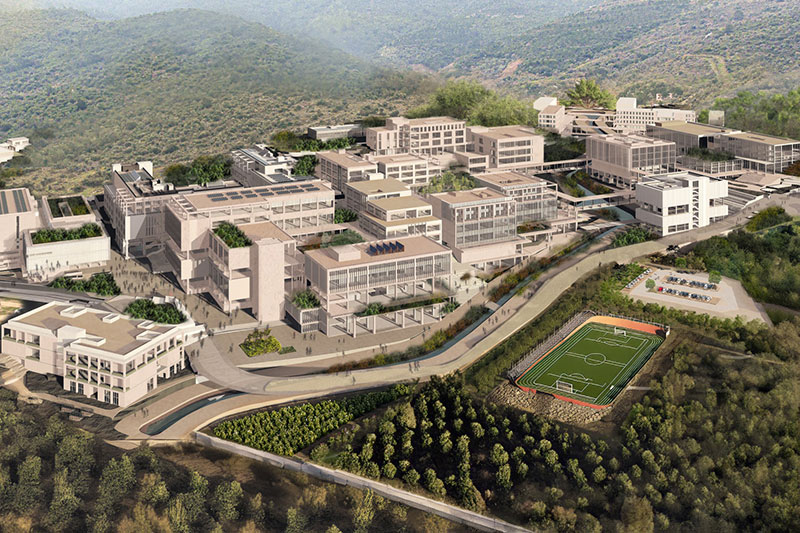
IZMIR UNIVERSITY OF ECONOMICS GÜZELBAHÇE CAMPUS
DetailsGLOBAL CAREER
As Izmir University of Economics transforms into a world-class university, it also raises successful young people with global competence.
More..CONTRIBUTION TO SCIENCE
Izmir University of Economics produces qualified knowledge and competent technologies.
More..VALUING PEOPLE
Izmir University of Economics sees producing social benefit as its reason for existence.
More..
You are one step ahead with your graduate education at Izmir University of Economics.